Rethinking Nuclear: Educated Publics? Manufacturing Consent? Emphasising Values? Assessing the Growing Global Trend of Legitimising Advanced Nuclear

Table of Contents:

Introduction

A striking feature of the debates surrounding nuclear energy is the strength of feeling exhibited by both proponents and opponents, the often intensely visceral reactions that characterize debates surrounding a technology that only very small number of people on our planet can realistically debate from a position of knowledge and expertise. Nuclear exceptionalism is a defining feature of the anti-nuclear movement and possibly there are good reasons for that. Nonetheless, narrative development and ideological positioning seem to play a huge part in identity formation, and the science, which is complex to say the least, often seems to be secondary in both the pro and contra narrative camps. I would argue that neither optimistic technological solutionism and determinism, nor anti-nuclear protestations based on solely the idiosyncrasies of nuclear technology are sufficiently nuanced. However, societal approval and sentiment are of critical importance in determining a country’s position on the issue, but are populations educated enough? Is consent being manufactured through narratives that push one agenda versus an opposing one? This paper is too short to answer these questions, but will draw attention to some survey data and academic findings that outline social license and public engagement work favouring nuclear as well as focusing on the re-narrativisation and ideological splits within the environmentalist movement. However, prior to delving onto these questions, I will begin with an assessment of the situation we currently find ourselves in by focusing on old fashioned supply and demand dynamics.

The Current State of Play

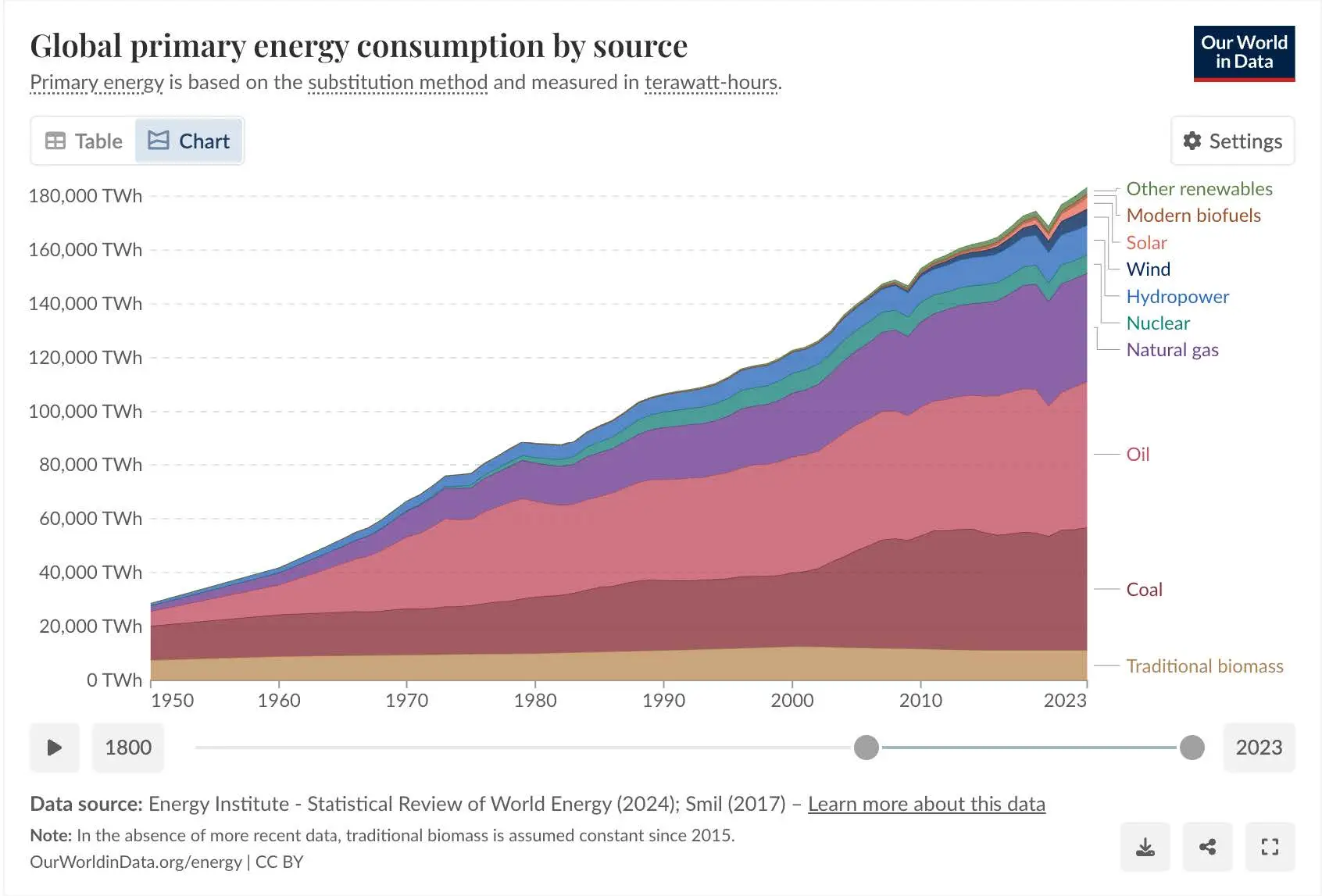
We have been going through an age of ever-increasing demand for electrons, driven by population growth, urbanisation and heightened reliance on mechanised and digital technologies. The global north has seen modest population growth combined with stable to falling per capita energy consumption in the last few decades. Both of these variables are growing at high rates in the global south, the latter from a much lower initial base1. Below is a summary of energy consumption by source since the 1950s:

Growth is linear with a clear upward trajectory. Moreover, the vast majority of energy we consume is fossil derived. The detrimental effects this has on the planet are well-documented and beyond debate.

We seem to be at a fork in the road and a simplified list of options (which are not binary but are presented as such below for simplicity) may be viewed thus2:

  1. Ramp up renewables
  2. Drill, baby, drill
  3. Technological solutionism
  4. Declining demographics
  5. De-growth
  6. Ramp up nuclear

There are numerous issues with each one of these, I tackle them in turn in the below:

1 Initially subsidised, renewables seem to have become economicly viable in most jusrisdictions as per MW prices of installed capacity dropped precipitosly in the last decades. Nonetheless, there are a number of significant unresoved obstacled on the road to renewables-enabled fossil independence. Environment-related concerns such as solar panel rare earth mining or disposal of wind blades are top of mind, as are the upper limits on renewables (ex hydro and biofuels) due to grid instability issues. Capacities currently required to balance solar and wind put a cap on these sources in the enrgy mix. Development of battery technology capable of storing renewable energy efficiently, releasing it when needed and transmitting it to where it is required has not yet been accomplished. Even when efficient storage is achieved, cable transmission over ultra-long distances (eg. sub-Medittranean) leads to sizeable losses. Finally, there are plethora second order effects that need to be considered. Large scale photovoltaic installations’ influence on global cloud cover patterns and potential reductions in photovoltaic potential in other locations3 is one. Ecological effects of large scale offshore wind is another.4

2 The new US President mantra sounds shocking to many, but it appears to be reflection of the global state of play as portrayed by the above graph. Looking backwards will not resolve the problems we face in the future. I always thought the Trump-inspired, MAGA-Brexit-Bolsonaro-Orban et al. 3P paradigm (popularism, polarisation, post-truth) can be caricatured as the dying cry of a dinosaur, but right now it feels like instead of floating down the river of fossil history, a movement that not so long ago looked like an anchronism is shaping energy policy towards preserving our fossil fuel dependence and inevitable addiction. The consequences would be dire. Lynas (2015) concludes his Ecomodernist Manifesto with the words “the history of the antinuclear movement is therefore not lit by sunshine, but shrouded in coal smoke”, and these fit well here.

3 Technological solutionism is a defining feature of Silicon Valley culture. It has virtue in its optimistic mindset and resulting occasional ability to create products and technologies that allow some to lift themselves in the air by their proverbial shoelaces. However, this strength is also its biggest weakness. Promises inevitably almost always take longer to materialise, noise and hype characterise the early stages of technological progress and it is usually only after many failed starts and iterations, a number of turns of the boom-to-bust wheel, that reliable solutions emerge, become stabilised and blackboxed in the infrastructures of tomorrow.

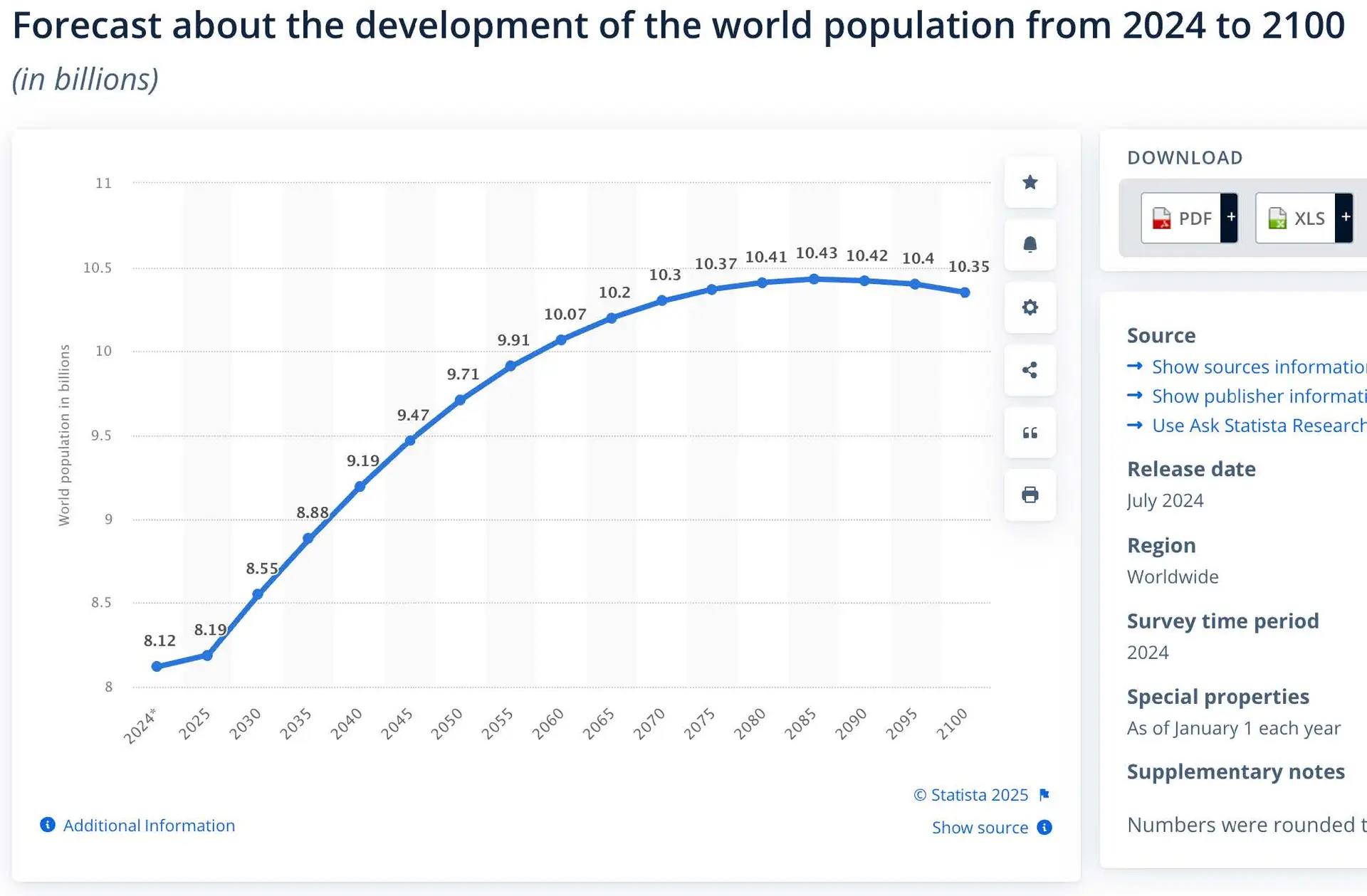
4 Just as demographics has played a huge role in the 6x increase in energy consumtion in the last three-quarters of a century, it will continue to play a key role in the future. Can one ignore Malthusian logics by relying on 3. above? Possibly, but since the 1950s the pattern of energy consumption seems to be a positively sloping straight line. Explaining why that would change would require some very creative tech solutionism, if world population grows to 10.5 billion as per the below forecast. In addition, our current thirst for AI is leading to huge additional electron demand and the rotes of AI entities that are joining our world will require even higher output.

5 De-growth is an attractive thought experiment, but might remain just that. Even if implementation succeeds in the global north and demand for power decreases, so many countries in the global south are coming from a low base and justifiably will likely not join this movement straight away5. They are also the countries experiencing high population growth.

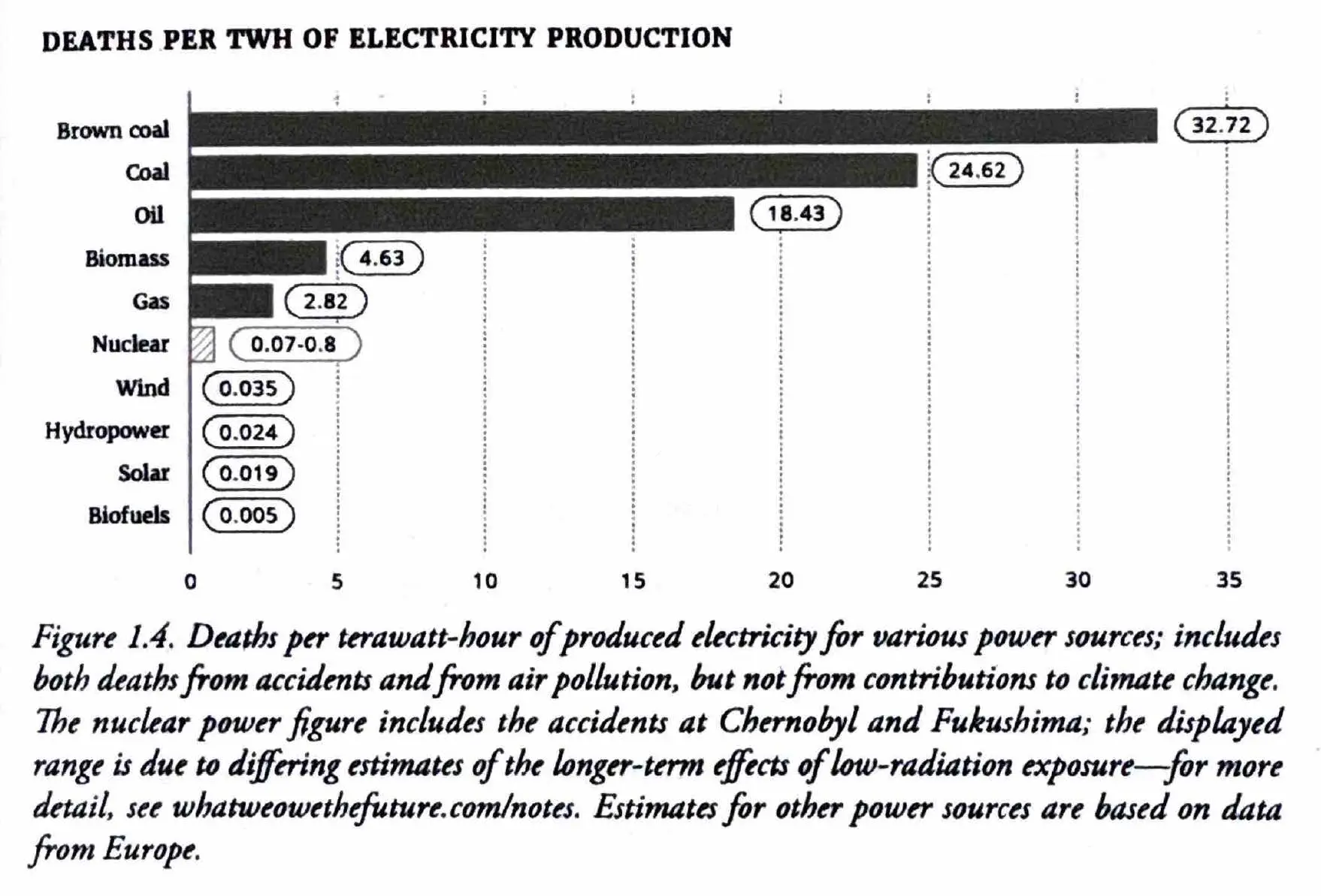
6 Finally, there is nuclear energy. The way this final option is perceived by publics is the topic of this essay, but this long prelude was required to sketch out some of the constraints which the world is facing and the limited workability of competing solutions. Some of the above logics seem to be the drivers behind nuclear environmentalism and the reinvigorated public support nuclear energy generation is currently experiencing. Figure 3 illustrates the relatively benign toll nuclear energy generation has thus far taken on humanity, even without accounting for the climate effects of fossil fuels.

Interpreting "Public Opinion"

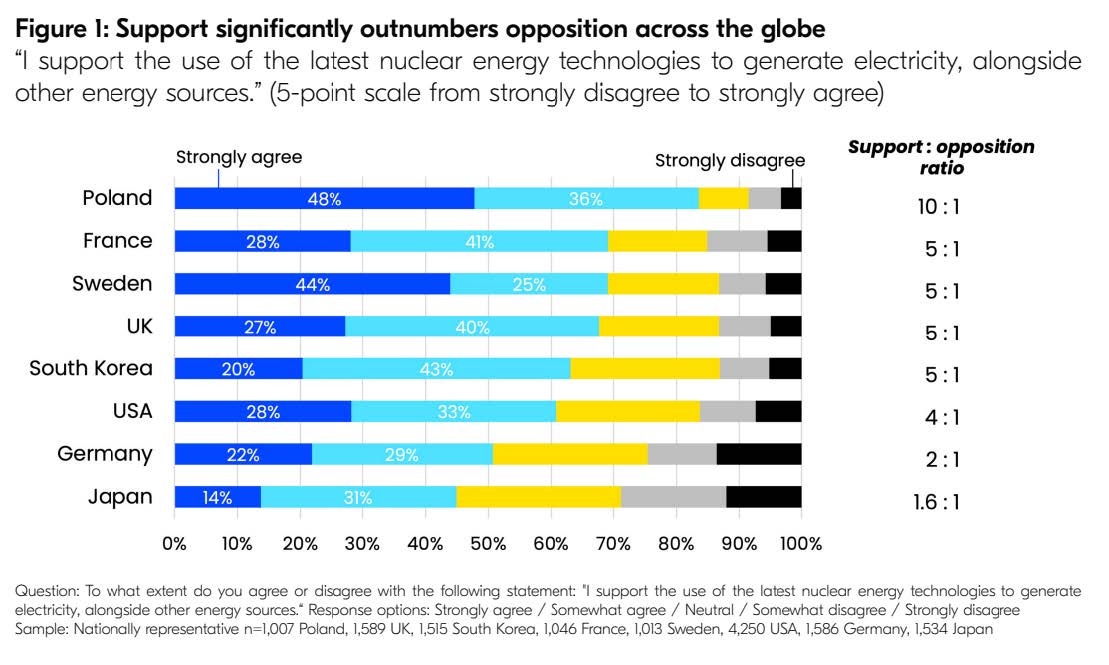
In a recent 2023 study, 13,500 people were interviewed in the USA, France, Germany, Poland, Sweden, UK, Japan and South Korea6. The study findings are overwhelmingly pro-nuclear in most jurisdictions, with support exceeding opposition (net of “don’t knows”) even in Japan7. Another study of attitudes towards the erection of deep geological repositories (DGRs) for nuclear waste storage in Switzerland carried out in 20178 documented relatively strong public support among the Swiss for the creation of a DGR with combined “against” numbers running in the low teens.

The question arises about how these levels of support are motivated, backgrounded, moulded in the belief structures of societies, some of which have very strong cultural afinities with environmentalism, politically prominent Green parties (Germany) and recent experience of nuclear disaster (Japan)9. How do publics form their answers to extremely difficult questions and what motivates these answers? Government information campaigns surely play a role, but deep technical understanding does not seem to be the main driving factor behind opinion.

The Atoms4Climate debate at the COP281210 inspired me to internally simplify the debate about nuclear as a sort of planetary Trolley Problem:

a) do not change direction, and continue paying the increasing human and planetary cost of powering skyrocketing energy demand with fossil fuels (see Figure 3 above);

b) swerve and adopt more nuclear into the energy mix, along with increased reliance on renewables.

The energy transition, if imagined in this way, comes at a cost due to both the renewable and nuclear pieces: focusing on nuclear, these include, inter alia, irresponsible mining practices, processing, waste storage, and of course disaster. We focused on all of these in turn during our seminar and space does not permit to go into much detail here. The focus of this paper is public perception and resulting translation into opinion.

This is where values and morality enter the analysis and foreground technological and scientific discussions.

George Monbiot’s epiphany is a fascinating case of a committed environmentalist turned nuclear zealot through a re-“conceptualisation of identity as arising from the telling of moreal stories… to create new discourses and recreate their own”11. Monbiot stated that the incident at Fukushima convinced him to support nuclear on environmental grounds. ‘Atomic energy has just been subjected to one of the harshest of possible tests, and the impact on people and the planet has been small,’ while ‘on every measure (climate change, mining impact, local pollution, industrial injury and death, even radioactive discharges) coal is 100 times worse than nuclear power’12. Here we see unmistakable traces of the Trolley logic – the cost benefit analysis of our current course vs the nuclear course is a reason for even a sworn environmentalist to swerve, in the wake of Fukushima.

Public opinion in Japan seems to be in support of nuclear in a ratio of 1.6:113. Shin (2017) provides some nuance to this data by stating that the post WWII pro-growth coalition which reigned supreme during Japan’s re-industrialisation has been less successful in promoting nuclear energy more recently. The government lost credibility in the aftermath of the disaster, not least due to the conflicting and often erroneous information it provided to the general public in order to avoid creating panic. Nonetheless, the ratio of proponents to opponents of nuclear in Japan is the lowest of all the countries in the survey cited in Appendix 1, but at 1.6:1 it is still significant.

Another very interesting perspective on pro-nuclearity is provided by Saraç-Lesavre (2019). She proposes that the local community embraced the Carlsbad WIPP due to its sense of civic virtue, values and desire for autonomy. “Being an autonomous, responsible entrepreneur community was not ‘something done to them’ instead something they were trying to accomplish ‘on their own’… national nuclear waste futures and ‘national interest’ were to be carried by voluntary and hybridised individuals and communities.”14 The initial siting of the repository was determined by its geological suitability, but entrepreneurialism, values, national interest and self-autonomy seem to have been the societal drivers.

Stefanelli et al. (2017) in their work on the dynamics and stability of public opinion of siting nuclear repositories in Switzerland find significant foci on values and responsibility. Table 5 in Appendix 2 shows just how much justice and responsibility matter in guiding public opinion. Discourses grounded in communication, value acknowledgement and participatory and inclusive processes are deemed helpful in generating public support. The Swiss case is possibly special due to the grass-roots democratic principles of government that the country enjoys, but it is clear that as a rule of thumb, public opinion both shapes and is shaped by the values that matter to people. Top-down technocratic solutionism cannot dictate policy in direct democracies. Rather, active discourse and appeal to values and responsibility seem to be the driving forces moving the Swiss towards positive evaluations of repository sites.

Hoedl (2019) uses an updated social license framework to identify ways in which societal consent can be obtained, and the role of sponsors and governmental actors made clearer and more inclusive and effective by focusing on the four principles of a social license, namely “engendering trust, transparency, meaningful public engagement, and protection of health, safety and the environment”15. The paper concludes that “addressing societal concerns, whatever they may be, through a meaningful and transparent engagement process that engenders trust, is as important as technical innovation in order for nuclear technologies to have a role in responding to climate change”16. Four main lessons would aid technologists in gaining social license: a) aid governments in their attempts to gain public trust; b) regulation should go beyond safety and environmental provisions and address other public concerns that become apparent during outreach; c) no two projects are the same and in order to gain social license the engagement process should be crafted to suit the particular stakeholders, d) responsibility should be assumed for the entire life-cycle of a project in order to convincingly reassure stakeholders about the assumption of future risks. The last point here is possibly the most contentious one here as some spent nuclear waste isotopes have extremely long half-lives. Nonetheless, as Stefanelli et al (2017) show, an open discussion about values can lead to gaining social license and approval.

Concluding Remarks

Concerns about values and responsibility inform views on our potential increased reliance on advanced nuclear technologies to power the world in the next decades. The formulation of increased adoption of nuclear power as a trolley problem exposes the moral difficulties associated with the choices humanity faces in an admittedly oversimplified way. However, the publics surveyed in the various studies briefly examined above do not appear to appeal to or profess deep technological understanding of the various technologies they opine on. Even after taking this course, I am eons away from understanding the intricacies of most things nuclear. This is not for lack of desire or trying, but rather has to do with the complexities of the various technologies and sheer depth of prior knowledge required. Societal consensus appears to rely more heavily on narratives, values and an appreciation that the planetary cost of the status quo cannot be sustained much longer, a sense of responsibility to the present, but also a desire to craft a more sustainable future.

I believe that there is also a different type of responsibility at play here: the responsibility to make difficult choices.

It is probably somewhat controversial to frame nuclear adoption as a trolley problem. However, the matter of responsibility weighs heavily and makes me wonder who we are accountable to. Ourselves? Our children? Their children? Our ancestors X generations from today? The environment? Other species?… It is clear is that nuclear energy is not a universal panacea, the deus ex machina that solves humanity’s insatiable thirst for energy. However, it likely does form part of a superior solution to the conundrum presented by our population dynamics and insatiable thirst for electrons. Opposing it on almost religious grounds17 is just one (seemingly fading) perspective out of many.

William McAskill, in his book What We Owe The Future, argues convincingly that taking an ultralong view in shaping the distant future should be a moral priority of our time. Some implications of this type of longtermism are obvious when we think about nuclear repositories. Projecting various paths of climate development into the distant future is more difficult. What is certain is that our actions today leave indelible marks on the fossil record and our future history and we should consider these in their totality as best we can, in order to bequeath the future a better world, rather than burden it with the leftovers of irresponsibility.

“The World Wants Nuclear”, Findings from a comprehensive evaluation of the world’s understanding and support for advanced nuclear. Survey presentation by Clearpath, RePlanet, Thirdway and Potential Energy Coalition (2023).

TOP 10 FINDINGS

  1. There is strong support for advanced nuclear in every country tested, with an average of five supporters for every opponent.
  2. Support is high everywhere (65-92%) once people come off the fence.
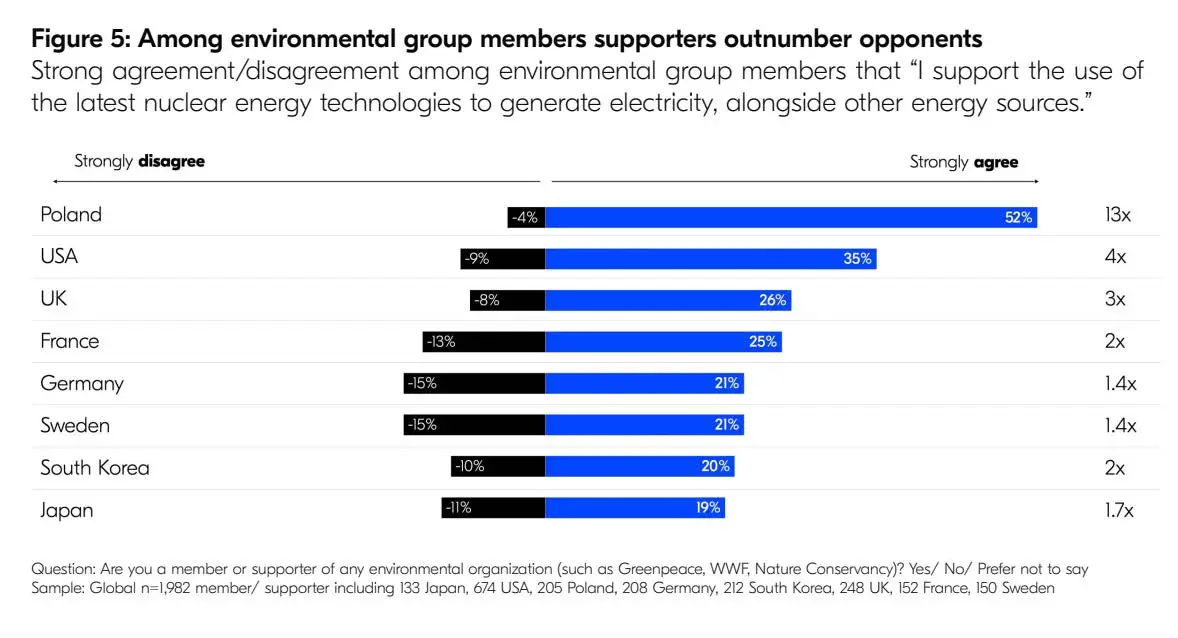
  3. Environmental group members are strong supporters of advanced nuclear.
  4. The young are particularly receptive, with little opposition anywhere.
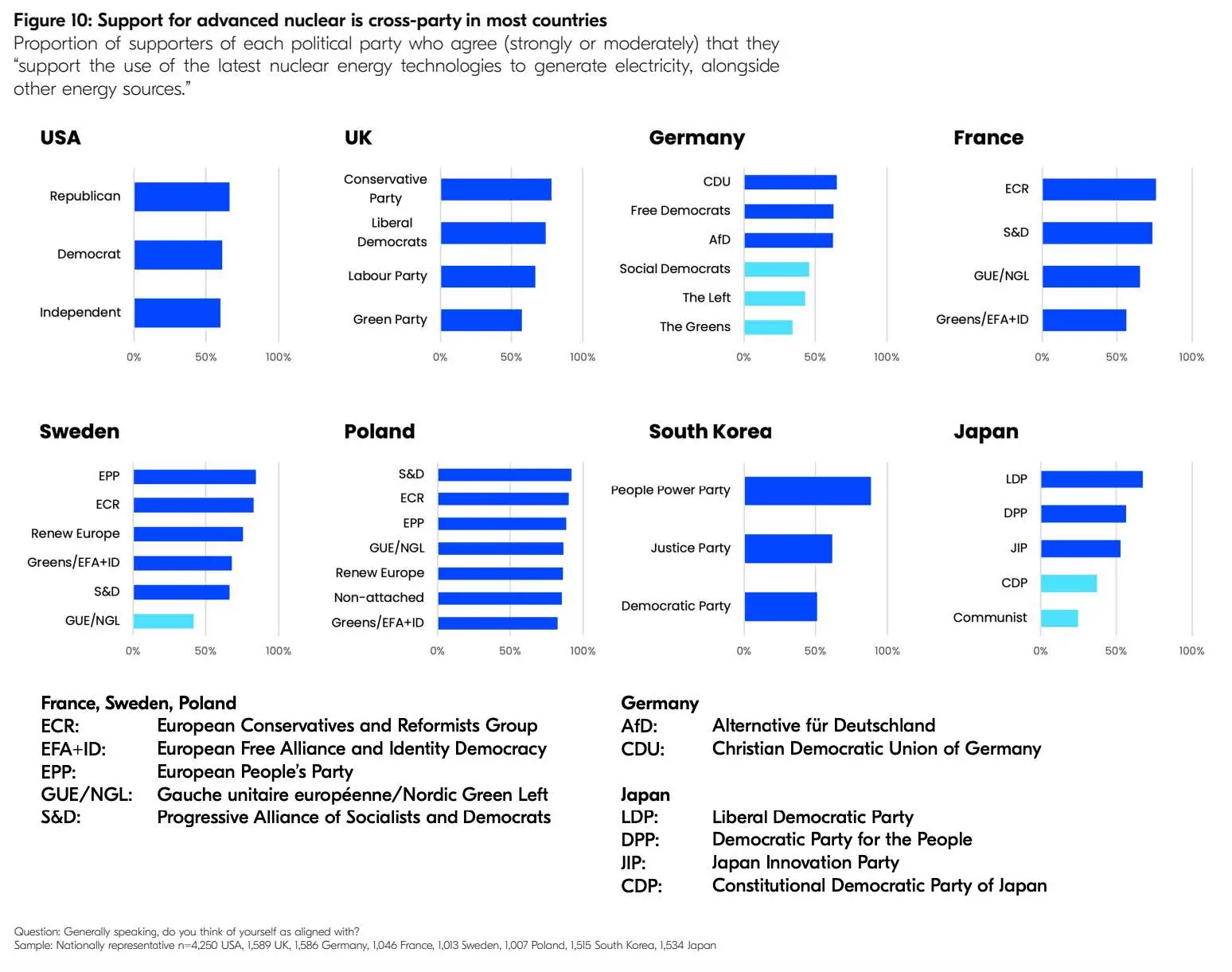
  5. Support for advanced nuclear is not political and comes from almost all parties.
  6. Most people see the need for and benefits of advanced nuclear, and are not put o- by perceptions of cost, safety, or waste.
  7. Four intuitive personas explain big country di-erences and the primary motivations behind support and opposition.
  8. Most people value the roles advanced nuclear can play to secure our future and are open to hearing about the issues.
  9. Almost all the opposition comes from a small, distinct segment whose members are older, skeptical about innovation, and unmovable in their views.
  10. Most people are receptive to the “nuclear” name and hearing from the nuclear industry, as well as from environmental groups.

SELECTED VISUAL REPRESENTATIONS OF SURVEY DATA

Reproduced from A. Stefanelli, R. Seidl, & M. Siegrist, “The discursive politics of nuclear waste: Rethinking participatory approaches and public perceptions over nuclear waste storage repositories in Switzerland”, Energy Research & Social Science, 34, (2017).

Table 5
Relative frequencies of categories by gender and general opinion, 2015. Numbers in bold indicate the main differences in the frequencies among the groups.

A. Stefanelli, R. Seidl, & M. Siegrist, “The discursive politics of nuclear waste: Rethinking participatory approaches and public perceptions over nuclear waste storage repositories in Switzerland”, Energy Research & Social Science, 34, (2017) 72-81.

Atoms4Climate debate at the COP28, https://www.youtube.com/watch?v=cnoTiOJ3LHM&t=36s.

B. Saraç-Lesavre, “Desire for the ‘worst’: Extending nuclear attachments in southeastern New Mexico”, Environment and Planning D: Society and Space, 38/4, (2019) 753-771.

C. McCalman, “Nuclear heresy: environmentalism as implicit religion” A thesis submitted in partial fulfilment of the requirements for the degree of Doctor of Philosophy, University of Sheffield (2018).

C. McCalman & S. Connelly, “Destabilizing Environmentalism: Epiphanal Change and the Emergence of Pro-Nuclear Environmentalism,” Journal of Environmental Policy & Planning, 21/5 (2015), 549-562.

H. Shin, “Risk politics and the pro-nuclear growth coalition in Japan in relation to the Fukushima”, Energy & Environment, 28/4 (2017), 518-529.

I. Galparsoro, I. Menchaca, J.M. Garmendia, et al. “Reviewing the ecological impacts of offshore wind farms” npj Ocean Sustain 1, 1 (2022).

J. Greenwald, “Why many environmentalists are warming to nuclear power”, Nuclear Innovation Alliance (2024), https://www.nuclearinnovationalliance.org/opinion-piece-whymany-environmentalists-are-warming-nuclear-power.

L. Long, Z. Lu, P.A Miller. et al. “Large-scale photovoltaic solar farms in the Sahara affect solar power generation potential globally”, Commun Earth Environ 5, 11 (2024). https://www.nature.com/articles/s43247-023-01117-5#citeas.

M. Lynas, Why a Green Future Needs Nuclear Power, An Ecomodernist Manifesto, (2015), https://www.ecomodernism.org/readings/2015/6/17/why-a-green-future-needs-nuclearpower.

R. Tuhus-Dubrow, “The Activists Who Embrace Nuclear Power”, The New Yorker, (2019), https://www.newyorker.com/tech/annals-of-technology/the-activists-who-embracenuclear-power.

S. Hoedl, “A Social License for Nuclear Technologies”, In: Black-Branch, J., Fleck, D. (eds) Nuclear Non-Proliferation in International Law – Vol. IV., T.M.C. Asser Press, The Hague (2019).

“The World Wants Nuclear”, Findings from a comprehensive evaluation of the world’s understanding and support for advanced nuclear. Survey presentation by Clearpath, RePlanet, Thirdway and Potential Energy Coalition (2023), https://zeroideas.org/wpcontent/uploads/2023/05/NewNuclear_Report_May2023.pdf.

W. MacAskill, “What We Owe The Future: A Million-Year View”, One World Publications, London, 2022.

Share the Post:

Leave a Reply

Your email address will not be published. Required fields are marked *

Publish on Epistemic Crossings

If you have an article or other types of content you would like to publish on this blog, please contact us:

Great! We’ve received your information.

We couldn’t process your submission. Please retry

To receive email updates, news and more

Footnotes

  1. See https://ourworldindata.org/energy-production-consumption.
  2. My analysis is partially informed by my situatedness and professional background in finance and economics. All of these points can be expressed in terms of demand side, supply side or technological development/efficiency/feasibility variables. This is a simplification of sociological dynamics, but one which provides a background angainst which sociology can do its work. Demographics are also an inalienable part of this; the dynamics change significantly if one assumes different population growth rates over a given analysis horizon
  3. See Long et al. for simulation results of the cloud cover effects of different scale Sahara photovoltaic developments.
  4. See I. Galparsoro et al.
  5. Norway annual consumption per person: 101,000 kWh, Austria 43,000 kWh, Nigeria 2,500 kWh, Pakistan 3,900 kWh. See https://ourworldindata.org/energy-production-consumption for more
  6. See “The World Wants Nuclear”, p. 4.
  7. A summary of the findings along with some of the most interesting visual representaitons are reproducend in
    Appendix 1.
  8. See Stefanelli et al 2017 for more detail. Main findings reproduced in Appendix 2.
  9. While Germany recently implememnted its decision to shut down its last nuclear reactors, Japan restarted reactors after precautionary shutdowns in the wake of the Fukushima disaster.
  10. See https://www.youtube.com/watch?v=cnoTiOJ3LHM&t=36s.
  11. C. McCalman & S. Connelly, p. 549.
  12. Ibid., p. 549.
  13. See Appendix 1, Figure 1.
  14. Sarac¸-Lesavre, p. 766.
  15. Hoedl, p. 1.
  16. Hoedl, p. 25.
  17. See McCalman (2018) for a very interesting comparison of environmentalism and anti-nuclear environmentalism as an implicit religion. Unfortunately, there is no space here to elaborate on the idea.